


EchoLab: A/B Testing Hypothesis Generator
EchoLab is an AI-powered experimentation assistant built for Product Managers who want to uncover the testable, high-impact ideas in less time. It combines latest LLMs, retrieval-augmented generation (RAG), and unsupervised clustering to transform customer feedback into actionable insights.
By learning from real PM playbooks and past product cases, EchoLab automatically generates experiment-ready hypotheses that product teams can act on — cutting the hypothesis setup time from 2 weeks in average to under 48 hours. This acceleration empowers product teams to run 5x more experiments annually, and bring measurable revenue for data-driven companies.
By seamlessly integrates with customer feedback sources and experimentation platforms, echoLab enables PMs move effortlessly from support tickets → insights → live A/B tests in a true end-to-end AI workflow.
Less triage. Faster cycles. More learning. EchoLab turns the backlog and feedback into a queue of high-impact experiments ready to drive growth.
Problem
Modern product teams receive thousands of customer feedback tickets every month through support platforms like Zendesk, Intercom, app reviews, and community forums.
While this feedback contains valuable product insights, turning it into actionable product decisions remains a highly manual process. Product managers often spend days reading tickets, identifying patterns, and brainstorming A/B test ideas before a single experiment can even begin.
Meanwhile, customer support teams repeatedly report the same issues, but those insights rarely make it into the product roadmap. Valuable customer feedback becomes trapped inside support systems instead of driving product improvements.
As companies scale, this workflow becomes increasingly difficult. More users generate more feedback, but product teams do not gain more time to analyze it. The problem for the product teams is slower experimentation, delayed product improvements, and missed opportunities to learn from customers.
We want to find out a solution for the product teams - let AI automatically transform unstructured customer feedback into experiment-ready product hypotheses, in hours instead of weeks.
Customer Segments


01
Product Team
(Primary User)
Who they are:
-
Product Managers
-
Growth PMs
-
Product Designers
Needs:
-
Discover high-impact product opportunities from customer feedback
-
Generate experiment-ready hypotheses
-
Prioritize roadmap decisions with evidence
Pain Points:
-
Manually reviewing tickets takes hours or days
-
Customer feedback is fragmented across multiple data sources
-
Difficult to synthesize and translate feedback into hypotheses
02
Customer Success / Support
Who they are:
-
Customer Success
-
Support Operations
-
Pre-Sales / Forward deployed engineer
Needs:
-
Surface recurring customer issues
-
Ensure customer feedback influences the product roadmap
-
Reduce repetitive issue triage
-
Close the feedback loop with Product teams
Pain Points:
-
Customer insights stay trapped in support tickets
-
Difficult to communicate recurring problems to product teams
-
Little visibility into product design
03
Company Leadership
Who they are:
-
Head of Product
-
VPs
Needs:
-
Increase experimentation velocity
-
Improve product decisions with customer evidence
-
Build a scalable experimentation process
Pain Points:
-
Slow learning cycles
-
Limited experimentation capacity
-
Limited visibility into emerging customer needs
-
Difficult to prioritize product investments
Persona


Customer Discovery
To understand how product teams discover experimentation opportunities today, I conducted Voice of Customer (VOC) interviews with Product Managers, Product Operations, and Customer Success teams. I also distributed questionnaires to capture broader feedback on experimentation workflows, customer feedback management, and current pain points.
What We Learned
Product Manager
“Honestly, 90% of my backlog ideas are gut feels . I know there are valuable insights buried in support tickets, but I rarely have time to dig through them before planning experiments”
Support Operations
“We see the same customer problems every week. I wish there were an easier way to surface those insights to the product team so we can improve the product instead of answering the same questions over and over.”
Leadership
“We want the team to experiment faster, but good ideas are the bottleneck. Too many roadmap items are based on assumptions instead of customer evidence.”

Customer Experience
1️⃣ Connect customer feedback sources
The Product Manager connects Zendesk, app reviews, surveys, and support tickets. EchoLab continuously ingests new customer feedback into a centralized knowledge base.
2️⃣ AI analyzes customer feedback
EchoLab filters out bug tickets and clusters similar product improvement issues, identifies recurring themes, retrieves relevant product knowledge, and summarizes the underlying customer problems.
3️⃣ Generate hypotheses
Using RAG and LLMs, EchoLab generates structured A/B testing hypotheses, including the target audience, success metrics, expected impact, and supporting customer evidence.
4️⃣ Review & refine
User reviews AI-generated hypotheses, edits details if needed, and selects the most promising opportunities for experimentation.
5️⃣ Export to experimentation platform
Approved hypotheses are exported to GrowthBook (or another experimentation platform), where the team can launch and measure experiments.
Feature Prioritization
Feature Frequency Impact Engineering Effort Priority
-----------------------------------------------------------------------------------------------------------------------------------
Hypothesis Generation High High High P0
Human Review & Editing High High Low P0
Platform Integration High Medium Medium P1
Multi-source Data Ingestion High Medium Very High P2
Team Collaboration Medium Low High P2
AI Input & AI Output
Input
- Raw Ticket Text: Full body of the customer message, including subject line, conversation thread, and tags
- Metadata: Ticket creation time, product area, user type, frequency of related tags, language
Output
- Ticket Label: Each ticket is labeled as BUG or IMPROVEMENT (with confidence score), and only improvements enter the A/B stream
- Cluster Theme: A short, human-readable label describing the theme (e.g. "Onboarding Drop-off", "Navigation Confusion", "Slow Search Results")
- Generated Hypotheses: 2–3 structured A/B test ideas per theme
Data Pipeline
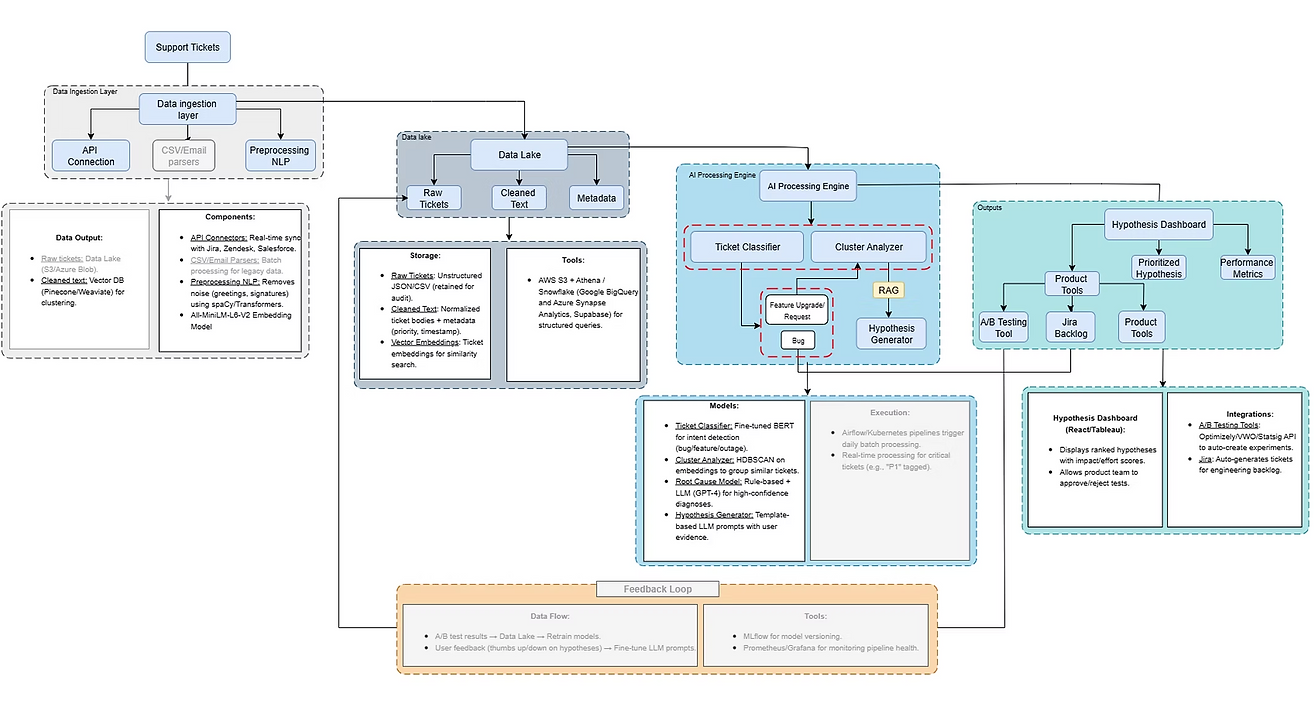
The data pipeline processes incoming Zendesk tickets in near real-time, classifying them as bugs or improvement opportunities, clustering related feedback, retrieving context, and generating either A/B test hypotheses or bug tickets.
1. Ticket Ingestion
Zendesk tickets captured via webhook listener
Metadata (e.g., product area, tags, timestamp) appended to the payload
Raw content stored in Postgres for processing and audit history
2. Preprocessing & Classification
GPT-4o classifies each ticket as either BUG or IMPROVEMENT
Branch logic determines downstream path:
If BUG → Bug Clustering
If IMPROVEMENT → Hypothesis Generation
3A. Bug Ticket Flow
Qwen 3 embeddings generated for bug tickets
Clustered by semantic similarity to identify recurring issues (e.g., “login fails on mobile,” “checkout crashes”)
Cluster summary, example tickets, and metadata compiled into a structured bug report
Displayed in the Bug Insights section and optionally pushed to Jira (on roadmap)
3B.Improvement Ticket Flow
Qwen 3 embeddings generated for improvement tickets
Clustered into UX themes (e.g., onboarding confusion, navigation issues)
Clustered tickets labeled and prepared for hypothesis generation
4. Context Retrieval
Top 3 relevant trunks retrieved from internal knowledge base using embedding search
Sources include past experiments, UX patterns, service documentation, and design guidelines
5. Hypothesis Generation
GPT-4o prompted with:
-
Cluster summary
-
Retrieved context
Generates 2–3 structured hypotheses with variables, test suggestions, and metrics
6.Output Delivery
Improvement Flow: Hypotheses auto-synced to GrowthBook as draft experiments
Bug Flow: Clustered bug reports shown in Bug Insights, optionally synced to Jira or tracked via dashboard
Tech Stack
------------------------------------------------------------
Frontend :TypeScript, React/Next.js, Tailwind CSS + shadcn/ui
----------------------------------------------------
Backend: Python with FastAPI / Java with REST
-----------------------------------------------------------
AI Models (LLMs): GPT-4o (OpenAI API) + Qwen3
------------------------------------------------------------------
Embedding & Retrieval: Qwen3
--------------------------------------------------------
Database: PostgreSQL with JSONB support
------------------------------------------------
Background jobs: Celery + Redis (Docker)
----------------------------------------------------------
Architecture
AI Evalution
Success was measured across three layers: product adoption, business impact, and AI quality.
The goal was not only to generate hypotheses faster, but also to ensure they were accurate, actionable, and trusted by product teams.
Results:
- Experiment Setup Time reduced 85%( from in average 2 weeks to under 48 hours)
- Hypothesis Adoption Rate > 50%, and increase to > 80% after human edit
- 5× more experiments launched annually
- Retrieval Recall > 98%
1 / Product Success
-
Experiment Setup Time Measures the time required for product teams to generate an experiment-ready hypothesis from customer feedback.
-
Hypothesis Adoption Rate Measures the percentage of AI-generated hypotheses that are accepted
-
User Satisfaction Measures how satisfied Product Managers are with the AI-assisted workflow
2 / Business Impact
-
Experimentation Capacity Measures the number of experiments product teams can design and launch within the same period
-
Revenue Improvement Pending
3 / Model Evaluation
-
Retrieval Recall Percentage of relevant case studies retrieved for knowledge base
-
Hypothesis Quality Score Human evaluation on a scale from 1 to 5 of how valid the hypothesis generated is
-
Hallucination Rate Percentage of made-up outputs
-
Groundness Percentage of supported output
-
Average Hypothesis Generation Time System speed
-
Output Consistency Measures whether similar customer feedback consistently produces stable and reliable hypotheses
Product Evolution and Roadmap
Phase 1 — MVP (4 months)
Scope
-
AI-generated experiment hypotheses
-
Customer feedback clustering
-
RAG-powered knowledge retrieval
-
Human-in-the-loop review
Success
-
Reduce experiment setup time by 85%
-
Generate hypotheses in <48 hours
-
>50% hypothesis adoption rate, >80% hypothesis adoption rate after human edit
Phase 2 — Workflow Integration
Scope
-
GrowthBook integration
-
Multi-source feedback ingestion (Zendesk, Slack message history, App store...)
Success
-
Eliminate manual context switching
-
100% positive feedback from users
Phase 3 — Product Copilot
Scope
-
Multilingual support
-
Additional platform integration
-
Continuous customer feedback monitoring
-
Dashboard & analytics
Pending future customer discovery and product validation.
